
As soon as one is in time,
time no longer flees.
Standing still, it opens out.
The Fourth Dimension, 2001[1]
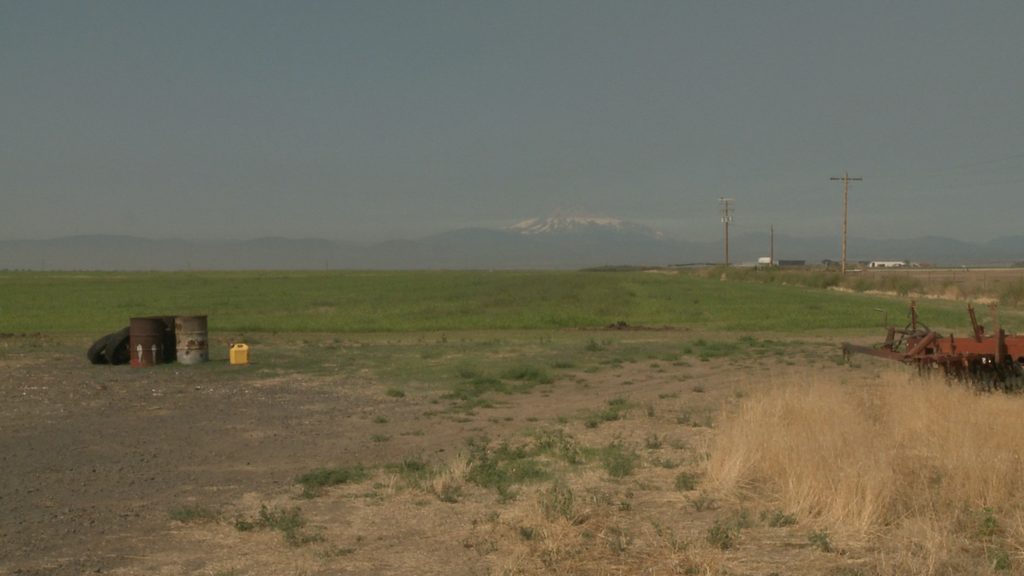
The film begins with a shot of an open, flat and vast rural landscape. In an extreme close-up, some patches of dry earth surrounded by sparse vegetation. A little further away, a fertile-looking agricultural field. In the background, several kilometres away, a mountain range with a few snow-capped peaks shrouded in summer haze. From left to right, three rusted iron barrels, a yellow industrial plastic drum and two old tyres. On the edge of the frame to the right, an old, abandoned plough. Receding into the distance along the side, several telephone poles. At first glance, an unremarkable landscape that, for those unfamiliar with the finer details of the geography of the United States, could be any random spot somewhere within that vast territory.
After a few minutes, the shot begins to settle in. I scan the image in every direction while continuing to scrutinise each element: What do those barrels contain? Does that yellow canister have traces of pesticides or fertilisers? And the plough? Who used it and for whom? The minutes pass and the questions multiply. Suddenly, I am reminded of some photographs from The New West: Landscapes Along the Colorado Front Range,[2] taken by Robert Adams and published in 1974. People are also generally not present in most of his photographs, yet the traces of human activity on the land are clearly visible. Adams belonged to the “New Topographics”[3] group of photographers who, breaking away from the tradition of monumental landscape photographers such as Ansel Adams, sought to shift the gaze towards the real, everyday environment of the new American West in order to understand landscape as a historical, political and economic construct.
Returning to James Benning, I wonder why he chose to place the camera in that spot and not another. The chosen landscape feels familiar to me within his filmography, and I recognise several elements that refer to his cinematic universe. I am aware that this is not a random choice. As Julie Ault describes in her text “Using the Earth as a Map of Himself: The Personal Conceptualism of James Benning”, Benning explores a broader geographical area before starting a film or selecting locations, conducting meticulous research into its context and paying attention to the meanings it might acquire.[4] Moreover, in this particular instance, Benning was pursuing the path of the totality of a solar eclipse, and this objective also determined his choice.
I return to the screen with a sense of unease, the feeling of not only wanting to see more, but also that there is still something left for me to discover. The spot where Benning positioned his camera, initially devoid of novelty or obvious interest, begins to encompass everything I wish to see at that moment. In the vast majority of long takes depicting an action, the duration is sustained thanks to a camera moving from one place to another, following the characters or shifting spaces in a virtuosic, epic manner. In Benning’s case, the duration rests on the image itself, the sound and the chosen elements. Not only on the framed landscape, but also on how he has chosen to observe it. He selects a static viewpoint with no shift in perspective, as if the idea of viewing an object from various angles were unnecessary, and instead trusting one’s imagination and the space beyond the frame to create depth within an image. Benning’s approach in this film proves that we can circle an image without moving. Throughout the duration of the shot, viewers can get lost, drift away and return. Not only exhaust the image, but also grow weary of it and abandon it, only to come back to it later.
The film reaches the twenty-minute mark. I am still glued to my seat, although I feel as if I am next to the camera that is filming, in a state of complete merger with the observing eye. The economy of the body is linked to the economy of the language of cinema and, from there, to the economy of modes of production. Benning films alone. His working method prioritises a personal approach. Using a single fixed shot becomes an exercise in attention and trust. Surprisingly, the image already imprinted on our retinas begins to lose luminosity. Subtle shifts in light accelerate and night falls suddenly. In that brief moment of darkness, the soundscape envelops the theatre in gloom with an unsettling silence. After a moment of anticipation and suspense, we gradually return to the image that greeted us at the start of the film. It is the same landscape, now rejuvenated, with that fresh feeling that is experienced in the early hours after dawn.
A few minutes later, Leonard Cohen’s “Love Itself” (2001) begins to play, acting as a sort of second plot twist that disrupts the film’s sonic flow, which was previously dominated by the location’s ambient sound. The choice of this song acts primarily, and through the title, as a tribute to the Canadian artist, who had passed away nine months before Benning shot the film. Nonetheless, juxtaposing original imagery with sound elements or music from other works or artists is a recurring feature of Benning’s filmography. In some instances, this act of appropriation connects his films to a map of affective references, while in others it is used to present a territory as a site of political dispute. In L. Cohen, by contrast, this relationship between image and sound is embodied in a more intimate manner: the music emerges once the light has transformed our perception of the scene. After the darkness, as the landscape reappears, the song completely redefines our connection to an image that we thought we had deciphered. What remains, what is transformed and what disappears over the course of the film, is reflected in the ideas of loss and impermanence that run through the song’s lyrics.
L. Cohen is a powerful cinematic experience. Forty-five minutes of a single shot that in almost symmetrical intervals encompasses two units of day separated by a brief night: the two minutes during which the Moon completely obscures the Sun. The film has an almost mathematical structure, based on the real-time observation of the eclipse: Day/Night/Day, with a sunset and a sunrise serving as transitional modes between light and shadow. This experience serves as a break with the real-time idea of “day” and “night” according to the conventions of calendar-based time. The eclipse acts as a parenthesis, inventing a fleeting night. Benning’s cinema demands real time and duration on the viewer’s body. The reward for this surrender is an experience that expands our way of perceiving time. As Erika Balsom notes in her analysis of Ten Skies (2004), an earlier Benning film composed of ten static shots of the sky, the filmmaker proposes “an alternative to dominant modalities of time and experience”.[5]
After attending a screening of James Benning’s Easy Rider (2012)[6] at the Centro Cultural Recoleta in Buenos Aires, I recall a colleague mentioning that she had briefly recalled her to-do list during one shot lasting approximately fifteen minutes – a hypnotic image of a current of water flowing over rocks – although, like a balm, she later returned to the image of the river. She expressed no guilt over that distraction, instead affirming that she felt free to make that decision, and that this digression was part of the experience. This freedom creates a space for intimacy and a secret dialogue with the image. The very antithesis of the frenetic system of consuming images from our mobile phones, where one image immediately replaces another. Algorithms accustom us not to engage deeply with what we observe. Daily scrolling is the failure of attention. Benning’s films, by contrast, remind us that there are other ways of conversing with images. Writing on the construction of new modes of attention in Benning’s cinema, Ault observes: “The close attention the film requires subverts conventional rituals of watching a film and awakens viewers to patience.”[7]
L. Cohen and much of James Benning’s body of work, such as casting a glance (2007) or RR (2007), focus on the depiction of landscape and the way in which it is transformed and revealed over time. The image is constantly constructed and reconstructed. Cinema as a blade slicing through time, allowing one to see far beyond. For both filmmaker and viewer, they are an exercise in observation and attention, a practice that Benning also developed pedagogically in his “Looking and Listening” course,[8] in which he asks students to spend hours in various locations observing and listening to their surroundings. Benning’s films work slowly within each viewer, in a space that is safe from the predictive analytics that dominate contemporary modes of visual consumption.
Benning also conceives of attention as a space of resistance. When asked about the relationship between political and aesthetic value in an interview I conducted with him in Buenos Aires[9], together with Agustina Pérez Rial and Ivo Aichenbaum, he replied: “I think there is a connection between the two and that the aesthetic I employ is also very political. The idea of allowing people more time to understand something is an aesthetic decision, although it is also a political one. Looking more closely and working harder to understand. Learning things always takes time, and I believe that learning can often be painful.”[10]
At forty-five minutes, the image cuts to black. I find myself thinking about how Benning’s films affirm that it is indeed possible to stop. There is no need to move more than is necessary. By trusting the image, there is time for it to emerge differently. I recall the words that Lucrecia Martel addressed to a group of students during a seminar[11] when she told them that she was against approaching reality with preconceived notions, without allowing things to reach us and permeate our being: “Invent cinema.”[12]
[1] Trinh T. Minh-ha, The Fourth Dimension (2001), the quote that opens the chapter “A Relation to Infinity: The Image and the Void”, in Trinh T. Minh-ha: Travelling in the Dark (Milan: Mousse Publishing, 2023), p. 99.
[2] Robert Adams, The New West: Landscapes Along the Colorado Front Range (Colorado: Colorado Associated University Press, 1974). This publication brings together photographs taken between 1968 and 1971 in Colorado that focused on housing developments and other forms of transforming the territory.
[3] “New Topographics” refers to the exhibition New Topographics: Photographs of a Man-Altered Landscape, organised by William Jenkins in Rochester in 1975 and featuring Robert Adams. The show explored the landscape transformed by human intervention, moving away from its romantic representation.
[4] Julie Ault, “Using the Earth as a Map of Himself: The Personal Conceptualism of James Benning”, in Barbara Pichler and Claudia Slanar (eds.), James Benning (Vienna: Synema Gesellschaft für Film und Medien, 2007), p. 92.
[5] Erika Balsom, Ten Skies (London: Fireflies Press, 2021), p. 72.
[6] James Benning’s Easy Rider (2012) is a work that revisits and reinterprets Dennis Hopper’s film of the same name, released in 1969.
[7] Ault, op. cit., p. 92.
[8] In the course that Benning has been teaching for many years at the California Institute of the Arts (CalArts), students are invited to spend several hours in various spaces, both urban and natural, with the aim of observing and listening attentively to their surroundings. The exercise is based on the idea that pausing in a particular place enables one to perceive aspects that would normally go unnoticed and to recognise that the same space can be experienced in different ways.
[9] An interview with James Benning conducted as part of the course he taught on the Film Programme at Torcuato Di Tella University prior to the screening of Measuring Change (2016) at the Friends of the National Museum of Fine Arts Association.
[10] Agustina Pérez Rial, Irina Raffo and Ivo Aichenbaum, “James Benning. El tiempo para ver una nube”, in laFuga, no. 21, Santiago de Chile, 2018, https://www.lafuga.cl/james-benning/912 (last accessed 1 October 2026).
[11] The seminar was part of the First International Film Festival organised by the Faculty of Architecture, Design and Urbanism (FADU) at the University of Buenos Aires, in collaboration with the Image and Sound Design degree programme. It was subsequently included as “Cómo armar un destino común” (How to Build a Common Destiny) in the book Lucrecia Martel, Un destino común. Intervenciones públicas y conversaciones (Buenos Aires: Caja Negra, 2025).
[12]Ibid., p. 148.