
On 3 March 1976, Spain’s armed police burst into the church of San Francisco de Asís in Vitoria firing shots. A workers assembly had occupied the church on the third day of a general strike that had brought various sectors of the city to a standstill. Five workers were killed and more than one hundred people were wounded, most of them by gunfire.
News of the demonstrations and the police charges mobilised Adolfo Girao, Tino Calabuig and Andrés Linares from the Colectivo de Cine de Madrid (Madrid Film Collective), an underground group that was using images to challenge and resist the regime (of visibility) of Francoism. Immediately following the event, they travelled to Vitoria to record images that would otherwise have been lost. Their documentary captured the public’s outrage at the police action and the criminalisation of an entire people by the media, as well as the grief of the victims’ families and the city’s mourning during the funerals.[1]
On 3 March, coinciding with the 50th anniversary of the event, the Spanish state finally recognised the building of the former church, now home to a nativity scene display, as a site of democratic memory and approved its reconversion into a memorial.
The second programme of the AMA Study Centre, curated by Arantza Santesteban and held between 26 and 28 February, joined the commemoration that the city of Vitoria has held every year for the past fifty years to commemorate the events of 1976. Under the title Memorias que vibran: los soportes de la memoria (Vibrant Memories: The Supports of Memory), the seminar involved jointly reflecting on the forms and discourses assumed by memory. Given that hardly any images of the aforementioned events have been preserved, this account therefore begins with one of them.
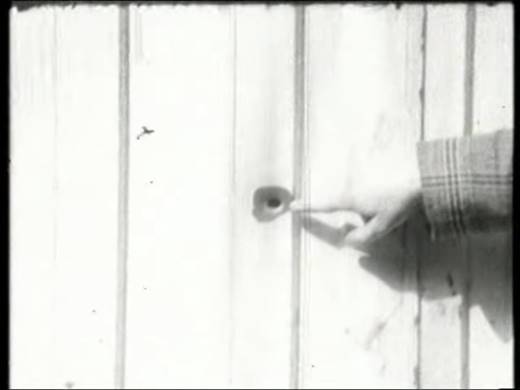
Like this finger pointing to a bullet hole, I suggest a similar exercise based on what was discussed during those days, in other words, a memory exercise about those years: recounting the gaps mentioned by the speakers in their talks and recalling the histories that filter through them like light and water. Gaps, along with blanks and failures, are common features of memory; metaphors and clichés describe this rugged geography and confirm that linguistic accidents are also physical, if not primarily so. In this sense, and in order to adhere to the programme’s subtitle, I recount gaps that open up on paper, rock or asphalt long before they open up in discourse. I speak of gaps because I speak of memory.
Carolina Cappa opened the seminar with an adapted question that cut across the rest of the meeting: from her experience as an archivist and film restorer at the Elías Querejeta Zine Eskola, she addressed the mould, humidity or tears that damage film. The question of what damage means to the film medium, or support, converges with the history of wounded cinema, a history of sick, contagious and sometimes incurable images. Their degradation is due to poor or non-existent conservation. In any case, this deterioration is twofold: first political, then chemical. The history of damaged cinema is almost always the history of militant, underground and marginal cinemas. Outside of the usual distribution channels, screens and archives, these films rarely leave their reels, or else they wait a long time to do so. In line with this injured history, Carolina Cappa reflected on the violence of archival policies and their technical and epistemological alternatives. She also considered the various responses to damage, ranging from historiographical lament to romanticisation and aestheticisation by militant imaginaries as evidence of their struggle and resistance.
The loss of a film leaves gaps in a filmmaker’s production or in the imaginary of a group that history is incapable of assuming. The relationship – obsessive because it is structural – between history and loss announces the importance of asking: what is the meaning of absence, if indeed it has any? The professor of art history María Rosón insisted on the active significance of the gap and its status as a historiographical object. Her words echo those written almost a century ago by Virginia Woolf:
Often the paper was scorched a deep brown in the middle of the most important sentence. Just when we thought to elucidate a secret that has puzzled historians for a hundred years, there was a hole in the manuscript big enough to put your finger through. We have done our best to piece out a meagre summary from the charred fragments that remain; but often it has been necessary to speculate, to surmise, and even to make use of the imagination.
The hole in the manuscript deprives us of a piece of Orlando’s life; the hole in the manuscript holds a secret. In contrast to history that seeks to be whole and complete, María Rosón celebrates complicity and confidence, the opportunity that the gap offers to imagine and desire a past that is accessible only through it. The hole disrupts the logic of integrity and transparency imposed by history, thereby undermining it. With regard to clarity, María Rosón revives the trope of the closet as a structure that defines 20th-century queer oppression, extending its use to Francoist oppression. The expression’s relevance lies in the fact that other binaries are debated within the closet, such as secret-revelation, private-public, unknown-known, or implicit-explicit, all of which constitute some of the most significant spaces of struggle in modern Western culture. In this sense, clarity as a condition for the possibility of (historical) knowledge is revealed to be part of an oppressive structure.
All the speakers agreed that history wants to be whole, even when its monuments crack, even when they fall. The CSIC researcher Germán Labrador, who has extensively studied the aesthetics and discourses of the Spanish Transition, as well as the sites of its memory, emphasised the many holes that riddle the country’s recent history: mass graves, cracks, craters.
Beneath the commemorative plaque dedicated to Prime Minister and Admiral Luis Carrero Blanco by the people of Madrid in 1974, which reads: “To honour his heroic death and perpetuate his memory”, a crack in the asphalt periodically troubles the City Council, whose maintenance services strive to fill. The fissure, a reminder of the crater left by the bomb, reappears suddenly and persistently. In it, in the impossibility of its definitive closure, Germán Labrador warns of the enduring disconnect between experience and discourse (about the attack, the dictatorship, the Transition, those years).
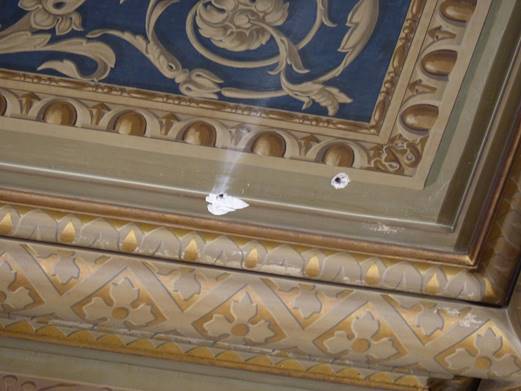
The country’s recent history is also expressed and embodied in the bullet holes that have riddled the Congress of Deputies since the attempted coup d’état on 23 February 1981: thirty-seven holes were detected in December of that year, thirty-three in 1999, and thirty-five in 2013. Over the last forty-five years, holes have been found, some uncovered and some covered up. The interventions and restoration work to which the building has been subjected during this time justify the fluctuating number, albeit not without controversy. Perhaps the agreement to preserve the bullet holes is one of the first exercises in democratic memory: today, in the Congress of Deputies, a display case holds a ventilation grille bearing a bullet hole.
Once again, and in line with the crack in Calle Claudio Coello, memory always finds unfortunate ways to inconvenience history.
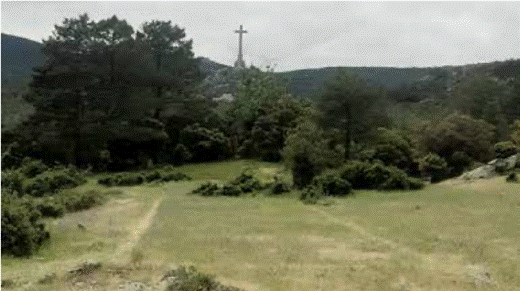
In fact, the most unsettling and dissonant of our monuments is a hole. On 1 April 1940, the year after the rebel troops’ military victory, Francisco Franco approved a decree ordering the construction of “a Basilica, a Monastery and a Youth Barracks on the Cuelgamuros estate, located on the slopes of the Sierra de Guadarrama”. This founding text already establishes the monument’s ideological framework: its religious and military rhetoric justifies the location (a crag a few kilometres from El Escorial) and the proportions (one thousand, three hundred and seventy-seven hectares of expropriated land, two million replanted trees, a two-hundred-thousand-tonne stone cross, a cavity two hundred and sixty metres long).
Paco Ferrándiz, a researcher at the Spanish National Research Council (CSIC) and advisor to the Secretary of State for Democratic Memory from 2020 to 2023, discussed the tensions and struggles that took place at Cuelgamuros.
In the year that the Valley of the Fallen was inaugurated, marking the twentieth anniversary of the end of the war, a process of recruiting bodies began: between 1959 and 1983, the remains of more than thirty-three thousand victims were forcibly taken there. In 2023, a forensic laboratory was installed inside the basilica for the first time, with the aim of recovering the remains of 128 Civil War victims claimed by relatives. Ferrándiz believes that the presence of a forensic laboratory in a former place of worship dedicated to the “Fallen for God and for Spain” represented a step forward in dismantling and reinterpreting the site.
Once again, it is in the hole where memory erupts and history is debated: a forensic team works in that hole every day to identify the skeletal remains of the victims, and a mass is celebrated for Franco and the fallen in that same place every day, Ferrándiz recalls.
The penal detachments of San Román, Banús and Molán[2] are located alongside the largest example of fascist architecture and landscape still standing in Europe. Their construction was part of a system of sentence reduction in which the state rented out the labour of political prisoners to companies: San Román, Banús and Huarte are among the best known of these contracts. In this sense, Paco Ferrándiz concluded by calling for a shift in the discourse on Cuelgamuros, which has until now focused on the monument itself, towards the shacks where those forced to construct it lived.
When discussing mould, secrets, gunshots and bombs, the speakers offered their own and at times indirect interpretation of the hole (as damage, as emptiness, as memory, as monument). At the end of this account, I realise a little late that they were talking about the same thing: perhaps the hole is the most fitting support for memory, at a time when the monument seems incapable of supporting it.
[1] Regarding the significance and emergence of underground cinema during the final years of the dictatorship and the Spanish Transition, I consulted the work of Lidia Mateo Leivas, whose research into the visual genealogy of the events in Vitoria was crucial: https://doi.org/10.1080/14636204.2017.1380150. The documentary is available online at the website of the Colectivo de Cine de Madrid: https://colectivodecinedemadrid.com/#videos
[2] The final report on the historical and archaeological research carried out at the Cuelgamuros penal detachments in 2021 can be consulted at the following link: https://www.mpr.gob.es/servicios/publicaciones/Documents/ArqueologiaValleCaidos.pdf