
Sonia: I recently decided to break my long-standing habit of social media before sleeping to read books, even though the contents are very similar. In my hands these days is Aimé Césaire’s Discourse on Colonialism. I already knew about it in English-language fragments, but I found a Catalan edition in Barcelona that I bought immediately to take back to Berlin. Rereading the first paragraph, which ends with the words “Europe is indefensible”, I could strongly feel today – yesterday and surely tomorrow – in those words of seventy years ago. Not only did it remind me of Palais, but also of our last encounter with another law court (ICJ) on the screen almost two years ago, during the South Africa vs Israel case… How do you feel about Palais, given everything that has happened since October 2023? How have other people felt about it or viewed it since then?
Alex: Interestingly, I’m being increasingly asked for this film. Not necessarily for public exhibition, even though it’s now in Artium Museoa. But word gets around and I’m asked for the link to see it, a lot more than when I made it. I revisited the Palais building a couple of weeks ago. I went with another person and got into places and hidden corners I’d never been to before: basements, a catacomb with a very narrow tunnel. I managed to get quite far into the tunnel before fear made me turn back. I went back up a bit, walked through a space, climbed some stairs and came across a type of doorway whose entrance was blocked by a light on a tripod. I jumped over the light and found a very organised archive of cases from 2019 to 2025. It was incredible that they weren’t locked away, but equally incredible that they were in a dark basement, with a light plugged in that way… it must be really strange for anyone going down there to pick up a folder. Looking through the folders, I found one labelled “Listening”, and when I opened it, I realised that someone’s phone had been tapped. It contained all of his conversation, his phone contacts, etc. This scared me in a different way, in terms of getting into trouble for looking at classified documents. At the same time, I wondered what all those documents were doing there. To cut a long story short, what I’m trying to say is that it was all a big mess!
For me, Palais acts as a caricature of the entire legal system and beyond. The constructs we have and fictions we create are quite sloppy. We impose them on reality, which is freer and more uncontrolled, in order to give it some form, some order, some kind control… and inevitably it has its flaws and shortcomings. Justice too, or even more so. It’s always fascinated me, although I’m losing faith in the judicial system. It’s just another tool for seeking “accountability”, a word for which I don’t know the Spanish equivalent. It is – or could be – another form of resistance, but it’s all built on rather shoddy, rotten foundations, and above all, it’s not applied equally to everyone. International Law, the United Nations, the 1948 Declaration… everything is built on an exception, which is precisely the Palestinian exception. There are many human rights as long as they don’t have to include Palestine. And this can be specifically seen today, when the United Nations approved the US-Israeli plan for Gaza, officially legitimising colonialism and occupation. It’s a major disappointment, because at some point, when I was very young, I believed in these structures, that’s how I was raised.
Sonia: I’ll reply in a roundabout way… When you were telling me about the case of the stacked documents, it reminded me of that project of yours – was it in Sweden? – where you sent letters and pretended to be other people… I can’t remember now what it was called…
Alex: But They Are Not You
Sonia: Listening to you talk about the enormous mess that is the law made me think of how, when I returned from Japan, I started to learn more about its imperialist past and its genocides in Asia, particularly in China and Korea. I remember watching a documentary about the Tokyo Trials, similar to the Nuremberg Trials, and being left with the feeling that the Nazis continue to be a paradigm that places Germany in a position of superiority. I understood that these trials sought “accountability”, pointing to the emperor as ultimately responsible for the deaths of between 20 and 30 million people. They lasted more than two years, with over 800 sessions, but they didn’t achieve much, probably due to American interests. They quickly realised that the collapse of Japanese society would follow the fall of the emperor. I seem to recall a high-ranking official saying something that accused the emperor in that convoluted language that is Japanese, but then he had to retract his statement and blame himself… Quite a charade.
Alex: A trial is ultimately like a battle of narratives. Whoever presents the most convincing narrative – or supposedly the most convincing – is the one who wins. The truth about the events being judged is supposed to prevail. In that narrative battle, when you say that if the emperor falls, then the whole of society falls with him, it’s because the entire narrative that sustains that society also collapses. Something very similar has been happening with Israel. Until now, it had managed to maintain the fiction that portrayed it as the only democracy in the Middle East, among other arguments. But Israel today has completely lost this narrative, at least internationally. All of Israel’s media and hasbara haven’t been able to overcome the reality of the situation. This is also thanks to alternative ways of circulating information, such as social media. And yet the United Nations has just approved this plan for Gaza. When the same people continue to hold power within these structures, with the United States’ veto power, for example, I don’t know how to defeat them other than by dismantling all these structures that aren’t serving us.
Sonia: The existence of a country or empire with veto power makes it very clear where we are… Although returning to your encounter with those documents during your incursion into the Palace of Justice in Brussels, I thought that something similar happens with the news or what I would call reality. In other words, they’re there, in a basement, but you have to go looking for them. You can find out what’s happening in Palestine, even though the basement is both closed and open at the same time: hidden yet unprotected.
Alex: Yes, but the history of Palestine isn’t hidden at all. You just need a little curiosity. All that information, all that history, is online and in books. It turns out that a huge amount of money and energy has been invested in keeping this reality hidden and completely ignored for so long.
Sonia: It’s on Wikipedia, in the Palestine entry; you don’t have to look far. There are also Wikipedia entries explaining how Japan offered occupied Manchuria (Manchukuo) and what is now Shanghai for the creation of Israel. All the facts are there, but perhaps what’s hidden or what I call the basement is the path. Access to information is very much like doodling. I myself have been surprised by my own ignorance, despite having been born and raised in places where support for Palestine is practically part of our operating system. But we aren’t taught that our well-being is sustained by the suffering of so many others. The justice system is also sustained by injustice as a practice and method.
Returning to 2020, the official date of Palais, the film that has brought us together here, I know you’ve already covered some of this, as I’ve listened to our podcast about The Tale and The Tongue again. The answers to questions I’m asking again are there, but I find it interesting that part of memory is forgetting and remembering. So let me ask you again about the beginning of your incursion into the Palace of Justice in Brussels, the city where you’ve lived for some time. I remember the views of the city from that square in 2006 and the sense of the building’s impenetrability. But also that it was set to one side, and how the views distracted from its monumental presence. It makes me think about how the European Union is and isn’t in a city that has something of a village feel, despite all the European bureaucratic apparatus. I’m asking you about your expectations before entering the building and how you felt leaving it, because sometimes we do things to confirm what we already suspected and other times to discover what we didn’t know. At the same time, experience erases things, just as dreams are erased when you recount them. I believe you made several attempts.
Alex: Before answering your question, I think what you’re saying is interesting. Indeed, when you leave the Palace of Justice, you have views of the city. But apart from the views you can have from there, the building is designed to be seen from any point in Brussels. It’s really high, in Les Marolles, a neighbourhood that was partly destroyed to build the Palace of Justice. And it’s designed that way so that you’re always reminded of the power of justice and punishment. It’s also interesting that you say the European Union’s headquarters don’t have much of a presence in Brussels. It has a neighbourhood, but it lacks the same monumental quality. Rather than imposing itself on the city, it’s more like a background “rumble”, a form illustrating the shift towards what’s known as “soft power”. It’s hidden yet omnipresent. So it’s interesting to make the geographical and architectural comparison between these two headquarters.
Returning to your question, I remember my motivation for entering stemmed from hearing about the building, how I’d been told it was crazy and that it would be interesting to go in and get lost… I was expecting a kind of labyrinth. I think my experience has probably changed since then because my way of being in the world has also changed. It’s much more politicised now than when I first went in there. So it impressed me a lot. I was impacted on formal and political levels by how it was constructed to affect a body passing through it. I also remember writing a short piece with an Alice in Wonderland vibe to it because you enter a large room in the building and feel tiny, then take the lift to the third-and-a-half floor and you’re in Being John Malkovich, feeling like a giant in a corridor where your head almost touches the ceiling. I found all of this interesting because of how this architecture is used to direct, disorient and intimidate… The building’s formal quality speaks volumes about the capabilities of a bureaucratic and legal system. I still bear this in mind when I enter the Palace of Justice, but now I’m much more aware of its history: how it was built, its origins, the history of Europe and the West… all of this in relation to a history of violence. It’s the same experience but with a different lens.
Sonia: You make me think about how my experience of Berlin has changed in recent years, including my relationship with music. Whereas before, dark electronic music was a gateway to a more European Europe, now I look for cumbia. For me, music is a matter of temperature. A girlfriend and I were talking about how much we now prefer the Neubau to the Altbau on our walks. It all stems from our weariness of German Europeanness, where Zionism is the “weather”. But there’s also a great deal of resistance here, and it feels more profound or serious than in other places. Demonstrating here is not the same as demonstrating in Barcelona. Just as it’s not the same demonstrating in minus five degrees as it is in fifteen. And there’s something about German urban planning that pains me and reminds me of this culture’s “anticipatory obedience” because of how identical the buildings are. For instance, during large pro-Palestinian demonstrations passing by the Bundestag en route to the Victory Column, I feel uneasy. They remind me of the parade-like feeling I had at a government-organised anti-AfD demonstration in 2018. I know they’re really necessary because they create that great aerial image of thousands of people, but they take place amidst German office architecture. It’s been a long struggle for pro-Palestinian demonstrations to be allowed to march through this area, yet at the same time, the Bundestag is emotionally overwhelming.
Alex: I lived in Berlin but left because the attitudes I encountered were very different from my own way of being or how I wanted to be in the world. Even so, I’ve been surprised by everything that’s happened in Germany. At first, I couldn’t believe it. But looking back, the feeling of something was already there.
Sonia: But another narrative that’s crumbling is that of German Zionism. And also the idea of German efficiency and Germany itself. I think this is very important in the context of the European Union, where talking to Europe once meant calling Angela Merkel. Being from southern Europe – or the north of the south of the north, as I like to say – you realise how Europe is an idea that excludes the south and the east. When people say “Europe”, they mean Germany, the Netherlands, Belgium and England, even though it’s not part of the European Union.
Turning to Palais, those of us watching the film accompany you on your journey. It’s one of those films where you know as much as the characters, nothing more. Like you, we’re afraid of intermediate floors, lifts and cigarettes that someone who’s no longer there has just smoked. Being a smoker makes it even scarier. We’re constantly on edge. We’re searching alongside you for something that we don’t know you’re searching for. What were you searching for? Is “search” the right word?
Alex: Well, I didn’t know what I was looking for. I usually never know exactly what I’m searching for when I create a piece. This has happened not only with Palais, but with many other films too. There’s an intuition or a curiosity or a desire that drives me. But even when I know the piece is finished, I don’t really understand what I’ve done. I just know there’s something there.
Sonia: I think that’s a good thing, Alex…
Alex: I remember I had to give a presentation on The Hand that Sings when Alma and I had finished it. I had to make one of those promotional videos, but they never used it because it didn’t turn out well. It didn’t turn out well because, when they asked me to explain what the film was about, I realised that I had no idea. Despite having made a film, and a very precise one, I still didn’t know how to put it into words. In the case of Palais, I was simply curious about the building and was keen on exploring and discovering it. I knew I’d understand things through that experience. It’s a building that surprises me every time I visit. And it’s strange because I know it, yet at the same time I don’t.
Sonia: I only went inside the building because of your film. It reminds me of cathedrals and how they’re assigned a style when they go through many other styles and periods. I say this after having used the cathedral in Santiago many times as a shortcut to get to university. The Palace of Justice also has something of a pastiche about it where one style leads to another, and you pass through the show window, the reception hall, the back rooms…
Alex: It’s actually very Brussels. There’s an architectural concept called “Brusselisation”, because on a single street in Brussels you might have a building from the 19th century, one from the 1970s and another from 2020, because of the indiscriminate destruction of old buildings at certain times. Brussels is anything but homogeneous, and the Palace of Justice is similar in this respect. It was interesting for me that when you watch Palais, you’re also watching a courtroom drama, a film about offices and power struggles from the 1970s, or The Blair Witch Project… But when I watch a film, I find it very difficult to see just one image. You’re always holding several images at the same time. That’s very evident in Palais, which is why it’s assembled in a more performative manner and less so on a computer. For example, if I had assembled Palais with more cuts, anyone who wasn’t from Brussels might have thought I’d invented the building by combining elements of many others. To avoid this, I had to walk, with the transition from the 19th century to the 1970s happening through a door with a body passing through it.
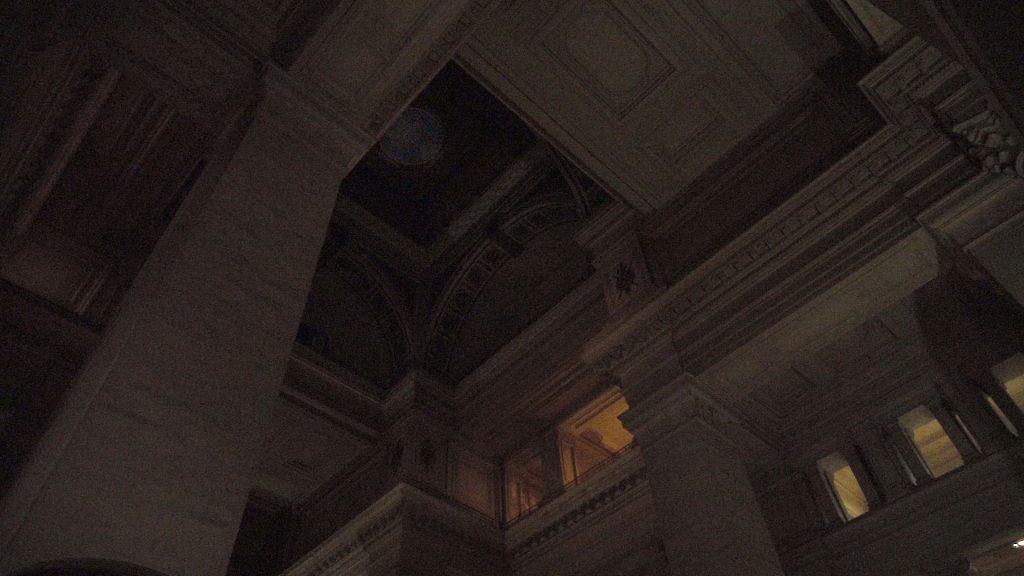
Sonia: I’m sure you’ve heard this a lot, but when I last saw it on my computer I was reminded of Sokurov’s Russian Ark and the Hermitage Museum, where I’ve also never been. It appeared to me like a flash, or the blink of an eye.
Alex: It’s very different, although I completely understand the association. Palais is made up of long takes where you gradually explore a building’s nooks and crannies. Sokurov’s film is almost like a filmed play. It’s all one long take where everything is prepared, staged and planned down to the last millimetre: it’s fiction. In that sense, Palais is the complete opposite, with hardly any production resources and no people appearing. It’s just me with a small pocket camera, not knowing what I’m going to find…
Sonia: Forgive me for always going back to my obsessions, but you make me think of DJs spinning vinyl. If you’re recording a mix and it goes out of sync, you have to start again from the beginning. Did this happen to you?
Alex: No, I didn’t repeat anything. That’s precisely why it’s different from what Sokurov does. I didn’t have a planned route through the building. I started walking and let my curiosity guide me. I came across everything for the first time. What’s more, I got lost. The drawings of Palais, from Foot to Eye to Hand attempt to retrace my steps while consulting the plans. I did them twice, but on paper, and even on paper I couldn’t manage to complete the route twice. While looking at the images on the screen and drawing with a pencil on paper, the second drawing always turned out wrong because I got lost, my hand got lost. There’s something to it because it’s very difficult to get to know that building or at least well enough to know a route later. Although I imagine if you work there, you always take the same route… I took so many different ones that sometimes I’d accidentally come across a floor I knew again.
Sonia: And were the drawings done before the filming, at the same time, or afterwards?
Alex: Afterwards, because they’re drawings of the long takes. What I did was use one of the routes, and while looking at it with my hand on the paper, I traced the video’s route on the paper, without looking at it. It’s basically a way of looking at the footage without getting distracted, a way of concentrating while editing the long takes.
Sonia: The word “game” comes to mind. I remember your film with Julia Spínola’s voice and in A Bunch of Questions with No Answer, even though I haven’t seen it. Or the game in courtroom dramas where the best argument wins, going back to the beginning and language as a technology that a priori also starts and ends wars… Are you doodling right now?
Alex: I am actually…
Sonia: Laure Prouvost did the same thing during a podcast conversation. Will you send them to me later? Doodles have a lot to do with offices and bureaucrats on the phone, at least before social media and so many screens. When thinking about the Vilaseco gallery exhibition, I first thought of asking you for the Palais drawings. They made a lot of sense with that Twister ice cream image I sent to all of you as a concept. But precisely because they made a lot of sense, they didn’t. It was too literal. The film for me is more like the experience of bureaucracy, which is a bit like video game… which I don’t think you like very much…
Alex: I do, but I didn’t want the film to resemble a video game. I enjoy playing them.
Sonia: Which ones do you like?
Alex: Before, when I was going out with someone who had lots of video games, I played them a lot. Also because I worked for ArtFutura for a while. I don’t remember most of them, but I liked Shadow of the Colossus, where you’re a warrior on horseback travelling through really beautiful landscapes for a long time before coming across a monster. I liked how peaceful it was, being able to hear the breathing of the character and the horse as it galloped through the landscapes.
Sonia: Returning to the quick association between bureaucracy and games, because of levelling up and how, just like keeping up with video games or current football news, as was the case with me for a while, the information in your head becomes outdated very quickly. With bureaucracy, you barely finish one process before you have to start another… Then there’s the constant fear of doing things wrong.
Alex: Of course, German bureaucracy is scary…
Sonia: I feel like I don’t do that much, and that scares me. But of course, I don’t have many things in my name. What I do is send letters to my girlfriends or to myself, to help us overcome our fear of the German letterbox. I also think of Mark Fischer’s Capitalist Realism, in which he argues that capitalism is a lot more bureaucratic than communism, yet presents itself as non-bureaucratic. Just browsing the Internet involves lots of bureaucracy. What’s your overall relationship or perception of bureaucracy in the systems you’re familiar with?
Alex: For me, it’s like a black hole of time. Growing up means having more and more bureaucracy. Wasting time with lots of papers, forms and the fiction of numbers in your bank account. I hate how much time it consumes.
Sonia: I get pleasure from doing it. I find it stressful to remember the method every year, but once I get it and understand it, I actually enjoy it.
Alex: I can give you mine… I don’t like bureaucracy. You’re also wondering if you’re doing it right, if there’s something they can catch you out on. There’s a law in your favour, but you don’t know about it until someone tells you five years later. Nobody explains to us how all this works; we’re helpless.
Sonia: Bureaucracy reminds me of something I think I heard Lazzarato say about democracy as a right-wing system that presents itself as neutral, and naturally any left-wing action has to contend with a counter-structure. There’s a documentary that specifically took place in Brussels about digital law, showing how acquiring rights takes much longer than eliminating them. We’re at a point right now where, if we weren’t aware of it before, it’s completely obvious that justice and what’s fair aren’t really the same thing. This reminds me again of A Bunch of Questions with No Answers, because I feel a connection to Palais that you can explain better than I can.
Alex: Even before Palais, I’d always been interested in trials, or the intersection of narrative and trial, the legal system as a kind of game with its own rules and loopholes where you can come across types of hidden corners. There’s also the question of hierarchy, which we tried to dismantle with Alma inThe Hand that Sings with respect to image, sound and word. I also made a piece called Second Person, Third Person, which deals precisely with bureaucracy and the asylum application process in France. I used the same strategy here as in A Bunch of Questions with No Answers. The first part consists of interviews with a “protection officer”, as they’re known, and an asylum seeker. What I did was remove the answers and kept only the questions, focusing on the worker and how that kind of bureaucracy functions not only within the structure of the form, but also the way in which a person improvises within the structure and embodies it.
In A Bunch of Questions…, we decided to remove the answers because we found them unbearable to listen to. What’s more, ever since Covid I’ve been studying Spinoza with some girlfriends, with an interest in dismantling hierarchies or situations where there’s a position of power. Spinoza specifically talks about how there’s no such thing as “joyful power”. By definition, you have power when you take away someone else’s capacity for action. When Rob and I watched the State Department’s press conferences, we felt our capacity for action being destroyed by how bleak, infuriating and depressing the answers were. At the same time, we witnessed the brilliant questions asked by the journalists in that room, day after day, questioning power, informed by their geopolitical and historical knowledge of the region, the history of US foreign policy. Yet they received evasive answers and rambling, wordy responses. This relates to what you said about language acting as a barrier against questions, demands for explanations or accountability.
One day, on the way back from a concert with Rob, the idea came up to remove the answers and keep only the questions. The next day, Rob started downloading all the videos of the press conferences and designing an algorithm to eliminate the answers. The truth is, we felt much less alone in that room when we listened to all the questions that we were asking ourselves, among us and with others, because we didn’t believe the narrative presented by the media. Having a whole group of journalists confronting power and saying “This makes no sense” gave us more capacity for action and a greater desire to continue working, resisting in whatever way we could within solidarity movements for Palestine. Now that we’re presenting the film, we feel it does exactly that, making you want to talk, to discuss, to take action beyond anger.
I think some of it has to do with Palais and how we compared the Palace of Justice to the European Union’s headquarters, to the fall of a mask and a narrative that, in A Bunch of Questions with No Answers, relates to the Biden administration as progressive. Let’s say it presents a time when people still thought it possible to get answers, that the legal system worked and that international law had some meaning. There was an attempt to appear to comply with the law, but this has now completely disappeared under Trump. The Biden administration was the final chapter in this democratic theatre, where journalists could still ask all the questions and demand all the answers.
We were also motivated to bypass media outlets whose editorial boards were censoring their journalists. We went directly to the anteroom that tells the whole story of that year and a half in context, calling things by their names, unlike the BBC, CNN and AP, whose journalists were in that room. It’s a historical document.
Sonia: I haven’t seen the film, but I do remember spending a lot of time scrolling through the questions that were posted online in text form that month. I only read certain media outlets and sometimes miss what’s being said in the mainstream. Also because it pains me. But interestingly in Galicia, with Nós, a historic, pro-independent, left-wing print newspaper, reporting on everything the others don’t, I came across news at the end of 2023 about the genocide and Palestinian journalists… in a remote village in the Mariña Lucense region, where you filmed that movie about girlfriends and zombies.
There’s a lot of talk about the distribution of power, but in my conversation with Terre Thaemlitz, she spoke specifically about how the goal should be the divestment of power, a word that forms part of BDS. Just recently, we saw how a journalist was fired for asking whether Russia should be required to rebuild Ukraine after all the damage it’s caused, and whether Israel should be required to do the same in terms of Gaza. I was moved to see another journalist pick up that question and ask it again. It reminded me of the importance of persistence, of taking up unanswered questions from colleagues so they aren’t left alone. I’ve long wondered about the effect of asking individuals, for example, what the national pavilions are going to do to get the Israeli pavilion removed from the Venice Biennale. Perhaps it would be more effective than a letter gathering thousands of signatures because of the constant presence of the same question. It’s really frustrating how colonial good manners are applied and “difficult” questions are met with criticism of the question or the person asking it.
Alex: The situation in which one journalist picks up on another’s question is very clear in A Bunch of Questions… Initially, there’s only one journalist, Said Arikat from Al-Quds, asking questions about Palestine, and throughout the film, the entire room joins in with him. There are several moments when one journalist takes up an unanswered question and repeats it, supporting a colleague. The camaraderie and journalistic ethics in that room can be seen. They do it for Shireen Abu Akleh, who was murdered by Zionists in 2022, asking about the investigation and its lack of consequences. A collective portrait unfolds as the film progresses, demonstrating a journalistic ethic that questions power and does its job.
In terms of divestment, this should also be applied with regard to attention and not only power. If you stop paying attention to certain narratives, they die.
Sonia: This is one of the current problems with fascism …
Alex: I think so. Fascism is winning, and perhaps this is partly because we lack the imagination in the arts and storytelling to generate other imaginaries.
Sonia: I think the problem is that we always play into their narrative. When I was on Twitter, there was a profile called “No les hagas casito” (Don’t Pay Attention to Them), or something like that. Do you remember?
Alex: Yes, but again it’s all about attention. If we’re talking about divestment, it would mean ignoring that narrative and paying attention to others in order to push different ones.
Sonia: Which is what has happened to Palestine for almost 80 years, everyone’s been ignoring its narrative. I try not to share it, but I admit that I’m very angry at Germany, and I fall into that trap. Of course, the algorithm reads it as important on a zero-one level.
Alex: I’m careful not to pay too much attention to and share things designed to elicit an emotional reaction of anger or indignation. Because I believe this diminishes our capacity for action. To a certain extent, they make you want to act, but what we actually need is to seek narratives that allow us to organise and unite in the struggle. I think some narratives simply isolate us in our anger, sadness and despair. It’s also about divestment from these kinds of dynamics, learning to recognise them and investing in others. A Bunch of Questions with No Answers was also a reaction to the short clips circulating on Instagram of exchanges between journalists and the State Department spokesperson, with answers designed to infuriate you, precisely because they served that same purpose. We wanted to move away from all that and be closer to a militant cinema that can bring people together to organise at a narrative, political and activist level.
Sonia: That’s true. With those frustrating answers, we focus on what is said and pay less attention to what is not said, which is perhaps more important. I’ve found myself in that state of despair many times. When others talk to me about despair, I tell them we can’t fall into that trap, that it even has a certain concessionary quality. It took me a long time to start wearing the keffiyeh in Berlin for what now seems an absurd reason: I wanted the same one I had when I was twelve, and I didn’t really understand its significance, but I wore it throughout high school; I suppose because of Yasser Arafat’s media charisma in the 1990s. When people talk to me about despair, I recommend they wear a keffiyeh in Berlin, because beautiful things happen to you when you wear one, and it helps you to know where you are and whom you’re with. Besides, as happened with Javier Bardem at that gala and as I experienced first-hand at some openings, it’s a “fuck off” to the glamour of art and a political statement on several levels. The keffiyeh is a basic element of support for the Palestinian people, who refuse to be gentrified.
What you say about narratives also reminds me of how we claim “victories” as our own but not failures or setbacks. I’ve been thinking for a while about how to make them more collective. Seeing other people’s cancellations and difficult processes helps us to follow a different path. It’s also part of the learning process.
Alex: Continuing with Spinoza, I also get furious about those “setbacks”. But then I think that we need to focus on something else. I can use the energy I’d spend cancelling someone for something much more constructive. I notice this when I work with other people collectively. When there’s anger about something, I try to move to something else, although I understand it might be frustrating for others. I try to think that each person does what they can, and that not everyone can do things perfectly, not even yourself. You also need the humility to recognise when you make mistakes, but to be able to continue despite them. I think it’s terrible to humiliate others, because you don’t learn much from it other than more violence. At the same time, everything has nuances, because there are groups that use shaming as a strategy, and I think this can work with institutions. For example, to pressure them or make them stop investing in Israel, etc. But I have serious doubts about using this strategy against individuals or artists who aren’t in positions of power.
Sonia: For me, it’s a case of shifting the blame, like when an abuser is singled out by other abusers using him as a smokescreen. When I get really angry, I try to ask myself why this is happening to me. And here I want to thank you for what you post on social media, because it often helps me to refocus on what needs to be done, on where the work to be done lies.
Alex: It’s also distracting to focus on small things. We lose sight of those truly responsible.
Sonia: Sometimes it’s about following the BDS call. I was saying this to someone about the Sónar issue. They know exactly what they’re doing and if they’re calling for a boycott, we shouldn’t make excuses… I could add many more things, but perhaps it’s time to leave it there? I think it’s a good ending to move beyond individual sadness to find each other in other narratives and places.
[This conversation between Alex Reynolds and Sonia Fernández Pan took place on 18 November 2025, with Alex in Brussels and Sonia in Berlin].